Physical Address
304 North Cardinal St.
Dorchester Center, MA 02124
Physical Address
304 North Cardinal St.
Dorchester Center, MA 02124
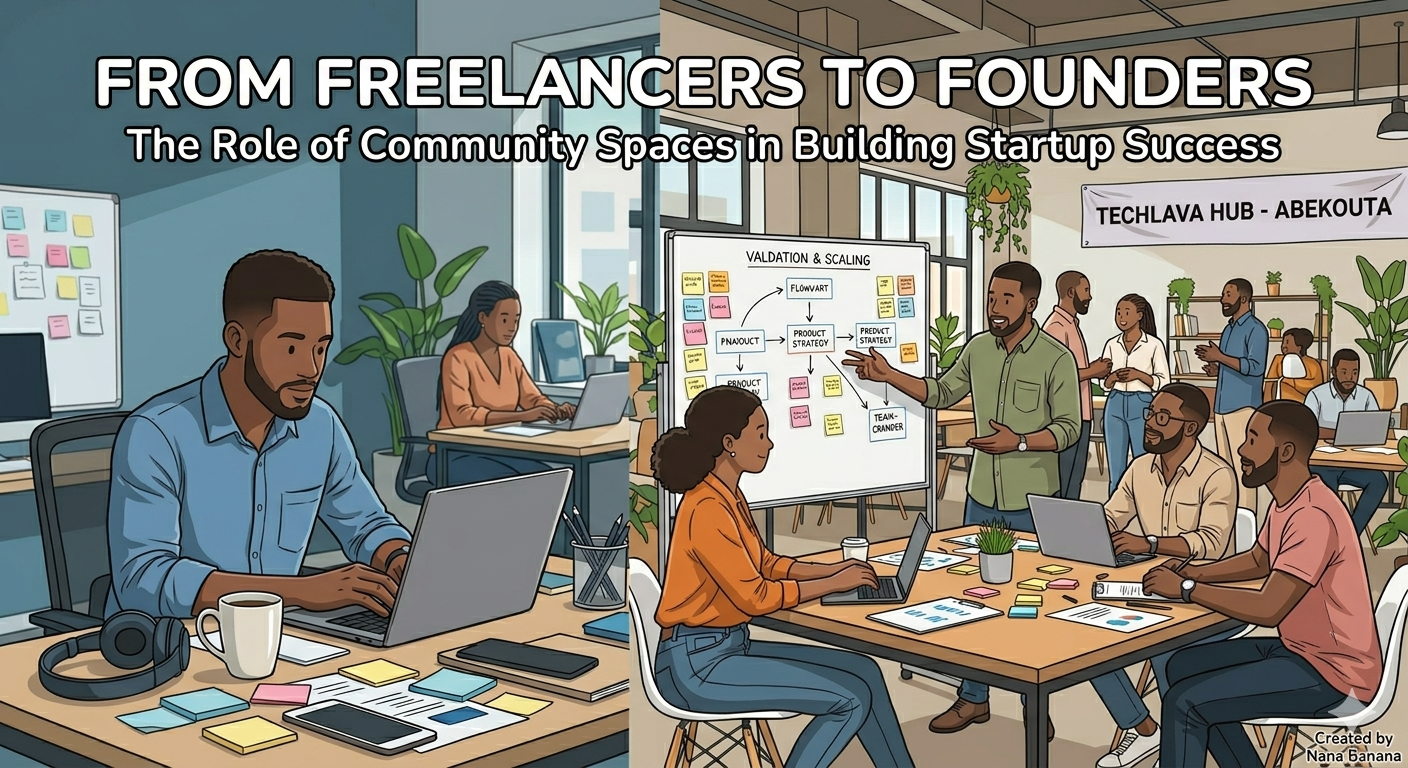
The journey from freelancer to founder is one of the most transformative paths in today’s digital economy. Across West Africa and the broader African tech ecosystem, thousands of individuals are moving beyond gig-based work to build scalable startups.
Yet, this transition rarely happens in isolation.
Behind many successful founders is a powerful but often underestimated catalyst: community spaces—coworking hubs, innovation labs, and developer networks that provide the environment, exposure, and support needed to evolve from solo work to structured entrepreneurship.
Freelancing has become one of the most accessible entry points into the tech ecosystem. Developers, designers, and product managers often begin their careers working independently, building skills and gaining exposure to global standards.
However, freelancing comes with limitations—income instability, lack of scalability, and minimal exposure to structured product development. Over time, many freelancers begin to recognize recurring problems across projects. Instead of executing tasks, they start thinking in terms of building solutions.
This shift marks the beginning of the founder’s journey. At this stage, many individuals begin exploring structured product development approaches, often similar to what is outlined in Techlava’s internal product strategy processes, where emphasis is placed on validation, iteration, and scalable architecture.
Community spaces are more than shared offices—they are ecosystems of opportunity. They bring together individuals from different disciplines, creating an environment where collaboration and innovation thrive.
For freelancers, this environment introduces a critical shift; proximity to people who are building and actively learning. Instead of working in isolation, they gain access to co-founders, mentors, investors and early adopters—people who tell people about what you are building long before marketing starts. In Abeokuta, Nigeria Techlava Hub is bridging that gap by creating a community where freelancers can build, and scale their own startups.
This kind of exposure accelerates the transition from freelancer to founder. It is similar to how structured engineering environments—like those used in scalable product development—enable teams to move faster and build more efficiently. You can explore how structured systems support scalability in platforms like Techlava’s software approach to building high-performance applications.
Many startups do not begin as formal business plans—they begin as conversations. In community spaces, a freelance developer might meet a product strategist who is also friend to a SEO expert. A designer might connect with a founder who has market insight but lacks technical expertise. These interactions often lead to collaboration.
This mirrors how successful products are built: not by individuals working alone, but by teams combining different strengths. As these collaborations evolve, freelancers begin to transition into product builders, adopting workflows similar to agile development environments used in modern software teams. This shift is essential for anyone looking to move beyond freelance work into startup creation.
One of the most valuable aspects of community spaces is access to mentorship. Being surrounded by experienced builders shortens the learning curve significantly. Organizations like Andela have played a major role in shaping Africa’s engineering ecosystem by training developers and exposing them to global standards. Many of these developers later go on to build startups, contributing back to the ecosystem.
Similarly, successful companies such as Chowdeck and Cowrywise demonstrate how local talent can scale globally relevant products. Founders from these companies are now reinvesting in the ecosystem, mentoring and funding new startups. This creates a powerful cycle: Community → Skill Development → Exposure → Startup Creation
In startup ecosystems, technical skill alone is not enough. Access to the right network often determines success. Community spaces provide: direct access to investors, partnership opportunities, talent pools for hiring and early customer feedback amongst other benefits.
For freelancers transitioning into founders, this network becomes a critical growth driver. It enables them to move faster, validate ideas earlier, and scale more efficiently. This is also why companies building scalable systems emphasize integration and collaboration—because growth is rarely achieved in isolation.
Starting a company requires resources—office space, infrastructure, and operational support. Community spaces reduce these barriers significantly. By providing shared infrastructure, they allow founders to focus on things like product development, customer acquisition, market validation.
This aligns with modern startup principles, where lean execution and rapid iteration are prioritized over heavy upfront investment.
Beyond resources and networking, community spaces influence mindset. Freelancers often see themselves as service providers. But in an environment filled with builders and innovators, that identity begins to change. They start to think: “I can build something of my own.”
This psychological shift is critical. Confidence, exposure, and environment combine to create a new identity—one that aligns with long-term value creation rather than short-term task execution.
Despite their benefits, community spaces are not without challenges. Distractions, inconsistent quality, and over-networking without execution can slow progress. Additionally, broader ecosystem challenges such as infrastructure gaps and funding limitations still exist.
However, structured communities—those with mentorship, programs, and clear focus—tend to produce better outcomes, for instance Techlava. The difference lies in how intentional the environment is.
The future of startup ecosystems, particularly in Nigeria, will be driven by community-led innovation. As remote work becomes standard and global collaboration increases, community spaces will continue to evolve into hybrid innovation hubs, distributed startup ecosystems, and global talent networks.
We are already seeing a pattern where today’s freelancers become tomorrow’s founders—and eventually, investors and ecosystem builders.
The transition from freelancers to founders is not just about skill—it is about environment. Community spaces provide the structure, exposure, and support needed to make that transition possible. They transform isolated talent into connected builders and ideas into scalable ventures.
For emerging ecosystems like West Africa, these spaces are not just helpful—they are foundational to long-term growth