Physical Address
304 North Cardinal St.
Dorchester Center, MA 02124
Physical Address
304 North Cardinal St.
Dorchester Center, MA 02124
In the modern business landscape, speed isn’t just an advantage; it’s a survival mechanism. However, many teams still spend hours every day drowning in repetitive administrative tasks, chasing down manual approvals, and hunting through messy shared folders.
If your team is still relying on memory, spreadsheets, and endless email chains to keep core operations running, consequently, you are losing time, money, and momentum. Automation isn’t a futuristic luxury anymore; instead, it’s a baseline requirement for sustainable growth.
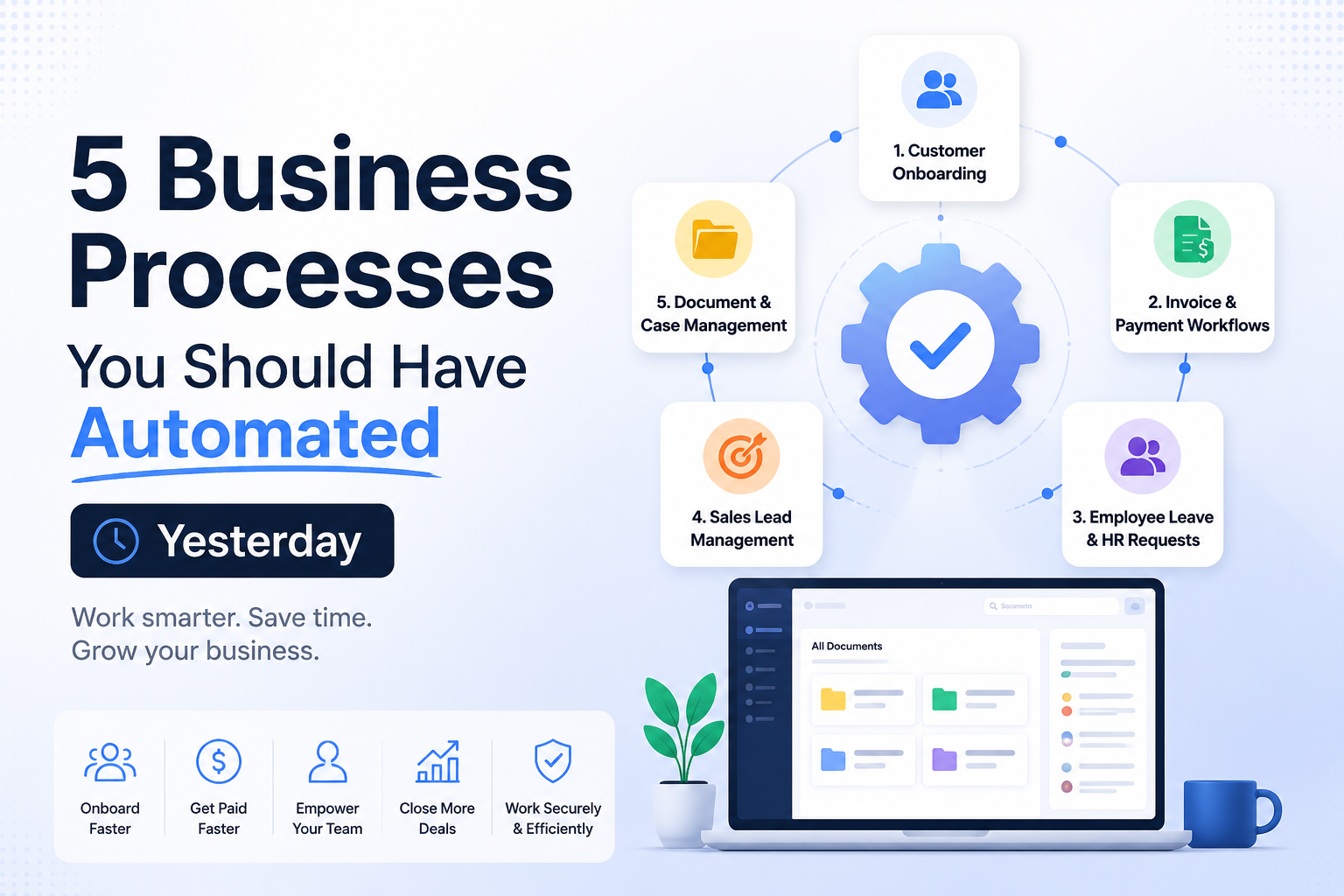
Here are five core business processes you should have automated yesterday, and how making the switch will transform your day-to-day operations.
First impressions are everything. The moment a customer signs a contract or buys your product, the clock starts ticking. In fact, if your onboarding process involves manual delays, inconsistent communication, and tedious back-and-forth, your churn risk skyrockets before the relationship even begins.
What to automate:
The Benefit: As a result, customers get to value faster, which reduces immediate churn while your team spends zero time answering repetitive “how-to” questions.
Cash flow is the lifeblood of any business; nevertheless, manual billing remains notoriously slow and prone to human error. Specifically, relying on an accountant to manually draft invoices, track down payment statuses, and send polite-but-firm nagging emails routinely delays revenue.
What to automate:
The Benefit: Furthermore, you get paid significantly faster, eliminate data-entry errors, and keep your financial reporting accurate in real time.
Your HR department should focus on talent acquisition, company culture, and strategic growth. Instead, a mountain of PDFs, spreadsheets, and emails often buries HR staff while they try to determine who can take next Friday off.
What to automate:
The Benefit: Consequently, employees receive answers in minutes rather than days, which liberates HR from the shackles of endless administrative paperwork
In sales, prospects measure response time in minutes, not hours. For example, if a hot lead fills out a form on your website and waits a full day for a salesperson to check their inbox, that prospect will likely move to a competitor.
What to automate:
The Benefit: Therefore, your sales team spends time actively pitching qualified prospects rather than hunting for contact details and manually logging data.
Organizations dealing with heavy compliance, legal, or operational workflows know that managing documents manually creates a massive bottleneck. In addition, when a team receives dozens of complex files a week, relying on legacy file structures leads to lost files, version-control nightmares, and missed deadlines.
Consider a busy legal or operational team managing multiple cases:
| The Old, Manual Way | The Automated Way (With SoftDox) |
| Emailing heavy attachments back and forth | Storing everything in a secure, centralized repository |
| Manually renaming files and guessing the latest version | Automatic version tracking and structured file naming |
| Tracking approvals via spreadsheets and sticky notes | Built-in approval routing and transparent history logs |
| Spending 20 minutes searching through nested shared drives | Instant, powerful keyword search across all documents |
| Missing deadlines due to siloed communication | Centralized dashboards to monitor case progress and alerts |
By Using SoftDox, teams can securely collaborate across departments, assign tasks to specific files, and monitor overall progress without ever asking, “Who has the latest version of this file ?”
The Benefit: Ultimately, spending less time on paperwork yields more billable hours, ironclad compliance, and greater value delivered to clients
Automation isn’t about replacing the human element in your business; rather, it removes the robotic tasks that slow your people down. Indeed, every hour your team spends manually chasing an approval, looking for a lost PDF, or typing a routine email is an hour stolen from innovation, strategy, and customer satisfaction.
The best time to automate these processes was yesterday. However, the next best time is today.
Start by picking just one process that causes daily friction, whether that’s streamlining onboarding, fixing billing, or centralizing document workflows with SoftDox. Then, measure the time saved, watch your team’s productivity soar, and build your automated engine from there.
Automation and efficiency are only half the battle. In contrast, true long-term growth requires systems and infrastructure designed to handle increased demand without breaking down.
Scaling requires far more than just adding servers; above all, it demands a bulletproof system architecture. Whether you want to train your engineering team in high-performance software development or need a custom strategy to scale your current product, contact Techlava Softwares today to see how we can help you build automated software systems that last.