Physical Address
304 North Cardinal St.
Dorchester Center, MA 02124
Physical Address
304 North Cardinal St.
Dorchester Center, MA 02124

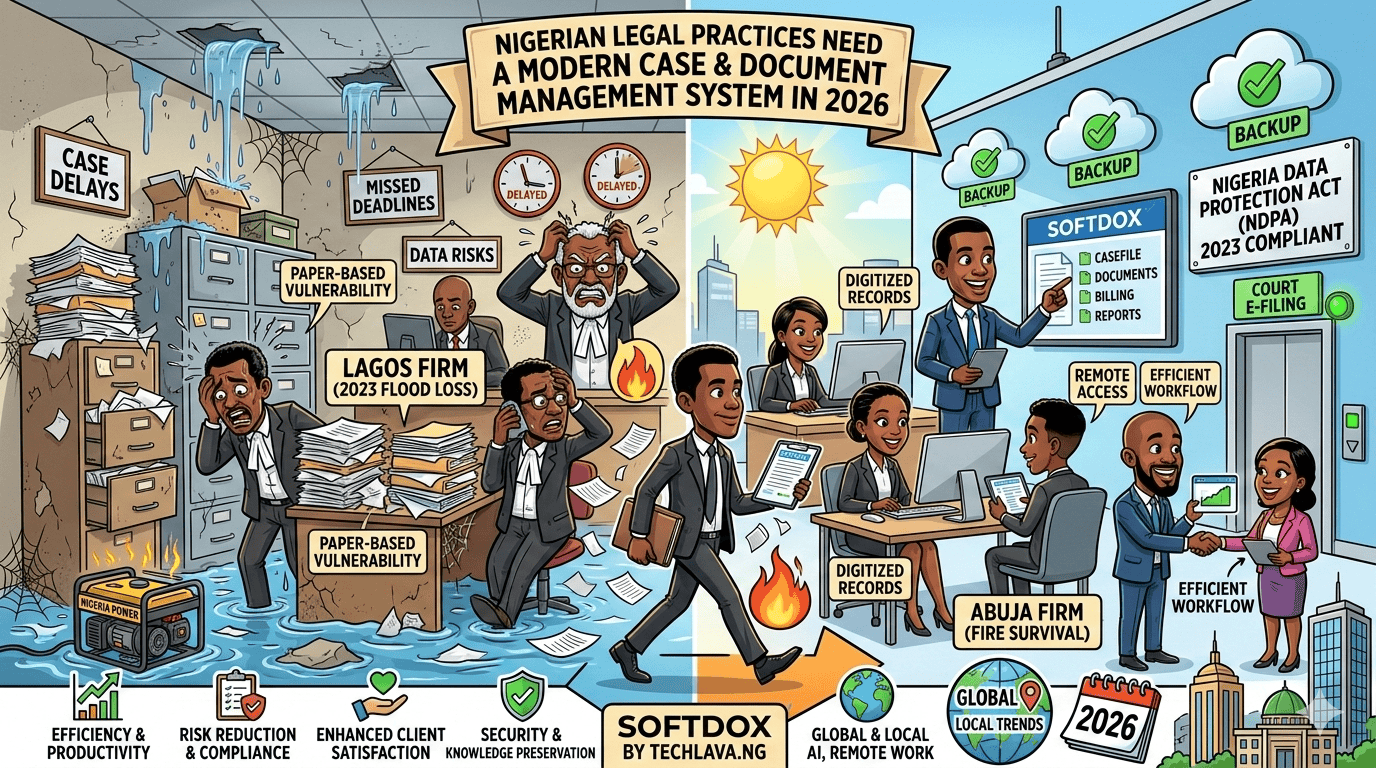
In 2023, a Lagos-based law firm lost critical property documents during a flood, leading clients to sue for negligence and damaging the firm’s reputation. This dramatic example illustrates the vulnerability of paper-based case files and disjointed workflows in a country where power interruptions, flooding, and unpredictable disasters are common realities. Meanwhile, an Abuja firm that had digitized all legal records with secure cloud backups survived a subsequent fire without losing a single client file. As Nigerian courts adopt e‑filing systems and lawyers increasingly work remotely, law firms can no longer rely on manual processes and paper archives. Furthermore, Nigeria’s Data Protection Act, signed into law in June 2023, imposes obligations on data controllers and processors to safeguard personal data. For legal practices, case files and client records now constitute regulated personal data; failing to secure and manage them properly could expose firms to compliance penalties and loss of client trust.
The Inefficiencies of Traditional Legal Workflows
Traditional case management in many Nigerian law offices revolves around physical files, spreadsheets and long email threads. A growing caseload may be every lawyer’s dream, but chasing down critical documents, liaising with clients and keeping track of court dates across disparate tools quickly leads to disorganisation. When information is scattered, firms run a high risk of forgotten filing deadlines, miscommunication and compliance errors. These setbacks waste hours on non‑billable tasks and can directly impact case outcomes and client satisfaction. The absence of a centralised criminal registry and ineffective case management systems in Nigeria contributes to persistent inefficiencies, with cases sometimes taking years to resolve.. Manual research and reliance on outdated precedent books further slow lawyers down. Before 2020, Nigerian practitioners spent countless hours poring over voluminous reports and consulting colleagues, yet the method was inherently limited, time‑consuming and prone to becoming outdated. In today’s fast‑paced environment, such delays can be costly: clients expect quick answers and transparent updates, and courts increasingly demand digital filings.
Regulatory and Market Drivers for Digitization
Several factors make digitisation not just desirable but essential. The Nigeria Data Protection Act of 2023 defines personal data broadly and requires data controllers and processors, including law firms, to implement security, audit and compliance measures. This law introduces categories of data controllers of major importance, imposes a duty of care and requires firms to engage licensed Data Protection Compliance Organisations for audits. Regulatory pressure is matched by technological change. Lagos and Abuja courts now use e-filing systems that require digital-ready documents and streamlined workflows. AI-powered legal research tools and remote or hybrid work arrangements are becoming mainstream, meaning lawyers must access case files from any location at any time. Corporate clients increasingly demand transparency and real‑time updates, which are possible only with digitised workflows. These drivers create an environment where paper‑based practices are no longer viable.
Core Benefits of Modern Case & Document Management
Efficiency and Productivity
Centralised, cloud-based case management platforms boost efficiency by giving everyone access to the same up-to-date information and automating routine tasks. When all case files, billing records and notes live in one organised platform, lawyers spend less time searching for documents and more time on substantive legal work. Automated workflows handle tasks like document generation, deadline tracking and matter assignment, reducing administrative friction and freeing up attorneys to focus on billable activities. Integrated platforms like CosmoLex allow law firms to create custom task templates, conditional workflows and dynamic deadlines that update automatically when dates change. These features translate to higher productivity, quicker turnaround times and, ultimately, higher revenue for the firm.
Risk Reduction and Compliance
Modern case management systems help law firms meet regulatory obligations and reduce risks. Digital archiving solutions use encryption, access controls and backup systems to keep sensitive case files safe. Cloud-based platforms provide audit trails and permission settings that demonstrate compliance with data‑protection requirements, giving clients and regulators confidence. Centralised systems minimise human error; automating scheduling, document management and deadline tracking lowers the possibility of oversights. For law firms practising in high‑stakes areas like employment or family law, missing a filing deadline could compromise a case; automated reminders and conditional workflows ensure key dates are not overlooked. Legal clients want partners who can anticipate and mitigate risks. When attorneys have quick access to detailed and updated materials, they can provide proactive advice and avoid problems before they arise.
Enhanced Client Satisfaction and Collaboration
Modern systems improve client experience by making information accessible and transparent. With centralised platforms, lawyers can quickly retrieve and share documents, giving clients real-time updates on case progress and building trust. A law firm that can deliver detailed, accurate information is regarded as a true partner. Cloud-based systems also enhance collaboration across teams; whether a firm operates from a single office or has adopted a remote or hybrid model, seamless collaboration is critical to delivering consistent service. Such platforms support remote work, enabling lawyers to access case files from any location, even during power outages or travel and to communicate with colleagues and clients through secure channels.
Security and Knowledge Preservation
Paper files are vulnerable to theft, fire, floods and other disasters. In contrast, digital systems use encryption, role‑based access and secure cloud backups, protecting sensitive information. The difference between the Lagos firm that lost documents and the Abuja firm that survived a fire proves that digitised records protect a firm’s reputation and clientsã€691366925646042†L135-L140】. Digital archiving also preserves institutional knowledge: precedent cases, internal memos and legal opinions remain accessible even when staff leaveã€691366925646042†L105-L115】. Without a strategy, valuable insights disappear with departing partners, leaving younger lawyers to reinvent solutions. By capturing institutional knowledge in a digital repository, law firms safeguard their intellectual capital for future generations.
Global and Local LegalTech Trends
Legal digitisation is a global wave. Filing systems are already in use in Lagos and Abuja courts, requiring digitally ready documents and robust workflows. AI-powered legal research tools help lawyers find precedents quickly, while remote and hybrid work models mean that lawyers collaborate across borders and time zones. Client expectations for transparency and real-time updates continue to rise. The National Judicial Institute 2025 workshop noted that filing and case management systems can reduce delays and administrative burdens, and that virtual courts and remote hearings cut travel costs and ensure continuity of proceedings. As technology evolves, law firms that adopt AI research, automation and online dispute resolution will deliver faster, smarter services, while those that do not risk falling behind.
Challenges and Considerations
Adopting digital case management is not without challenges. In Nigeria, infrastructure limitations such as inconsistent power supply and unreliable internet can slow adoption. Some senior lawyers are resistant to change, preferring familiar paper processes. Concerns about data security and hacking often cause reluctance. Cost considerations also pose barriers, particularly for small firms that fear digitisation is expensive. These obstacles can be overcome. Many platforms offer offline modes and mobile access, mitigating infrastructure issues. Pricing models are scalable, allowing firms to start with essential features and expand. The right partner provides training and change management to ease the transition. Moreover, modern systems employ encryption, two-factor authentication and regular backups to address security concerns. The bigger risk lies in not digitising: lost files, missed deadlines, and non-compliance pose more serious threats than the learning curve of new software.
Framework for Selecting a Case & Document Management System
When choosing a solution, law firms should consider more than cost. Below is a framework to guide decision‑making:
• Evaluate core features: ensure the system offers centralised storage, robust search, document versioning, calendaring, billing integration and automated workflows.
• Assess compliance and security: look for encryption at rest and in transit, role‑based access controls, audit logs and adherence to Nigeria’s Data Protection Act.
• Demand local support and training: vendors should provide onboarding, user manuals and responsive support tailored to Nigerian practice, including offline capabilities for areas with power or connectivity issues.
• Prioritise interoperability: choose software that integrates with your email, accounting and court‑filing systems, reducing duplication of data entry.
• Plan for scalability: select a solution that can grow with your firm, from solo practitioner to multi‑office practice, without forcing a costly migration.
• Consider user experience: intuitive interfaces reduce adoption barriers; test demos with actual staff to gauge ease of use.
How Techlava and SoftDox Stand Out
Techlava.ng is a Nigerian software development, project consultation and tech education company that understands the local context of law practice. Having built custom solutions for startups and enterprises across Africa, Techlava combines technical expertise with deep knowledge of regulatory requirements. Our team has delivered mission-critical software projects, trained aspiring developers and collaborated with businesses to solve real problems. This holistic experience informs our approach to legal tech: we focus on building tools that are secure, intuitive and tailored to Nigerian workflows.
Introducing SoftDox
Actionable Insights and Best Practices
Beyond selecting the right tool, success depends on how law firms implement digital workflows. The following best practices can help firms maximise the benefits of case and document management systems:
• Start with a pilot: digitise a single practice area or department before rolling out firm‑wide. Use the pilot to refine workflows, gather feedback and demonstrate value.
• Train your team: provide initial and ongoing training for lawyers and support staff. Encourage adoption through mentorship and by showcasing early successes.
• Document your processes: map out existing workflows and then configure the system to match or improve them. Clear documentation reduces confusion and ensures consistency.
• Establish governance: assign a data steward or team to enforce naming conventions, access permissions and retention policies. Regular audits ensure compliance and data integrity.
• Monitor and iterate: use built‑in analytics to track usage, identify bottlenecks and refine processes over time. Digital transformation is continuous, not a one‑time project.
Conclusion
The legal landscape in Nigeria is changing rapidly. In the face of natural disasters, regulatory pressures, and shifting client expectations, paper-based systems simply cannot keep up. The contrasting fortunes of two Nigerian law firms during recent disasters illustrate this point: digitizing case files and workflows not only protects documents but also safeguards reputations. Modern case and document management systems centralize information, automate routine tasks, enhance collaboration, and ensure compliance. Regulatory requirements such as the Data Protection Act, e-filing mandates, and the rise of remote work make digitization essential. Firms that embrace this shift will gain efficiency, reduce risk, and deliver superior client service; those that do not will find themselves outpaced and vulnerable
.Call to Action
Are you ready to future-proof your law practice? Techlava’s SoftDox provides a secure, scalable, and locally optimized case management platform specifically designed for Nigerian legal professionals. You can book a free project consultation, request a demo of SoftDox, or contact Techlava to explore how our expertise in software development, consulting, and technology education can transform your legal practice.





[…] Case File Management System and Workflow: A big reason lawyers burn out is that case tracking is scattered—WhatsApp messages here, files […]