Physical Address
304 North Cardinal St.
Dorchester Center, MA 02124
Physical Address
304 North Cardinal St.
Dorchester Center, MA 02124

Imagine launch day. After months of intense development, the marketing push is live. Hundreds, perhaps thousands, of eager users are hitting your application simultaneously. For a brief moment, it’s a victory. However, without proper load testing strategies in place, that initial victory can quickly become a system failure.
Then the system slows to a crawl. The API response times skyrocket. Users are met with dreaded 500-series error pages. Your team, already exhausted, scrambles to apply hotfixes under extreme pressure. Your launch, once a celebration, has become a reputation crisis.
This scenario is preventable.
When Techlava builds high-concurrency web platforms using Node.js or manages complex server migrations, we don’t just guess that the system works; we prove it. The difference between a smooth launch and a critical failure almost always comes down to robust performance engineering executed weeks, not days, before launch.
Many startup founders make the mistake of postponing load testing, arguing that they will simply fix scaling issues as they arise. This is a risky, and often fatal, assumption.
At its core, implementing comprehensive load testing strategies identifies the exact performance bottlenecks before your users do. It reveals whether a locking database query, an inefficient API endpoint, or CPU exhaustion in your application will bring the system down under pressure. Beyond just finding bugs, proving your system’s stability protects the reputation you fought hard to build. It also optimises your infrastructure spend; by understanding your true capacity and verifying that your auto-scaling rules actually work, you prevent expensive and unnecessary server over-provisioning.
Load testing isn’t a single switch you flip. It is a sophisticated strategy composed of different test types, each designed to answer a critical question about your application’s architecture.
Baseline Testing: Before you can stress a system, you must understand how it performs under perfect conditions. Baseline testing involves running a low-concurrency simulation—perhaps just five to ten simultaneous users—over an extended period. This establishes the crucial control data regarding average response times, memory usage, and CPU load. Every subsequent high-stress test will be measured against this baseline to accurately gauge performance degradation.

Normal Peak Load Testing: Once your baseline is established, you must simulate your expected “busiest hour” of launch day. During a normal peak-load test, traffic is ramped up linearly over 30 minutes until it reaches your estimated maximum simultaneous user count, then held at that peak for a few hours. The goal here is strict validation: response times must remain within your defined service level agreements (SLAs), and the error rate must remain near zero, proving the system can handle its intended audience.
Stress Testing the Breaking Point: You need to know exactly where your system breaks so you can plan for the worst-case scenario. Stress testing pushes traffic far beyond your estimated peak until the application begins to fail, which is usually characterised by high error rates or unacceptable lag. This intentional overloading exposes the weakest link in your architecture—whether that is the database, a connection pool, or a complex third-party API integration—and ensures the system recovers gracefully once the traffic subsides.
Spike Testing for Sudden Surges: Launch day traffic is rarely a smooth, linear curve; it often hits in sudden, aggressive bursts following a marketing email or an influencer mention. Spike testing transitions the system instantly from low baseline traffic to extreme peak load within seconds. This specifically tests your infrastructure’s ability to auto-scale rapidly and your application’s connection pooling under sudden shock.
Soak Testing for Endurance: Some critical performance issues do not appear immediately. Memory leaks, database connection pool exhaustion, and disk space issues accumulate gradually over time. To catch these hidden flaws, soak testing (or endurance testing) runs your normal peak load for an extended period, typically 24 to 48 hours. This ensures your application is stable over long periods of sustained activity and that temporary log files aren’t quietly filling your server disks.
Simply firing artificial traffic at a homepage will not yield useful data. You need a structured methodology to make your load testing strategies actionable for your engineering team.
The process begins long before the first test is run by defining clear Key Performance Indicators (KPIs). Your team must agree on what success looks like regarding average response times, the maximum acceptable error rate, and overall request throughput. Once these targets are set, you must translate them into realistic user scenarios. A user rarely just refreshes the homepage; they log in, search for records, download files, and process payments. Your test scripts must accurately mimic these complex, weighted journeys.
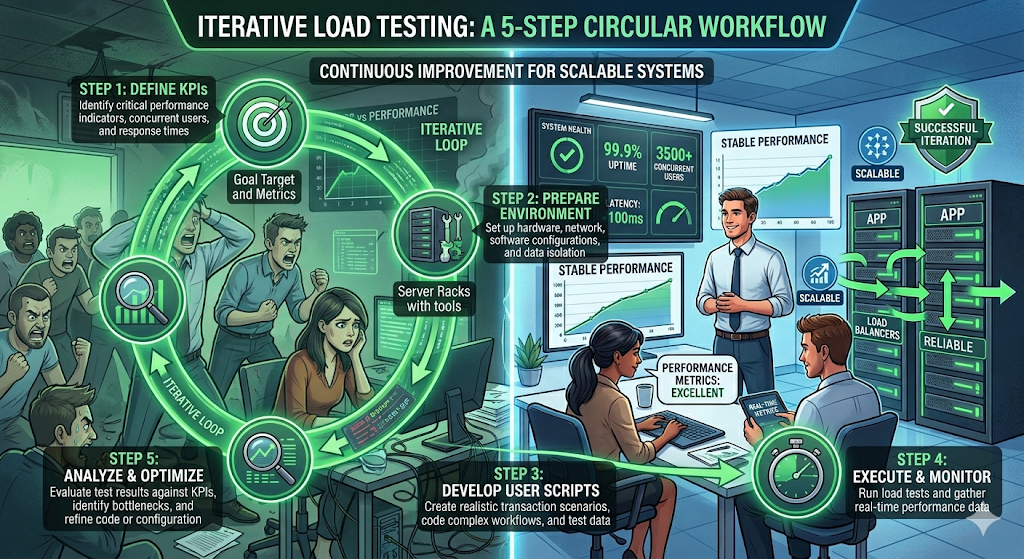
Crucially, these tests must be run in an isolated environment. Never load test against a production database or a shared staging server. You must build a dedicated performance testing environment that mirrors your production infrastructure exactly, populated with representative, anonymized data so that database queries perform exactly as they would in the real world.
Execution should always be iterative. Start with your baseline and light load tests, monitoring everything from application logs to server-level CPU and memory usage. When bottlenecks are identified—such as a blocked Node.js event loop or a missing database index—the team must pause, implement the fix, and run the exact same test again. You only move on to the next testing strategy once the current fix is verified against your original KPIs.
When it comes to tooling, the industry has largely moved past the heavy interfaces of older platforms like JMeter. At Techlava Hub, we prefer modern, scriptable solutions that integrate seamlessly into our CI/CD pipelines. For JavaScript-heavy environments, we highly recommend k6, which offers incredible performance testing power without a steep learning curve. Alternatively, if your team is more comfortable defining user behaviour script-first in Python, Locust is an outstanding open-source option that allows for highly complex, realistic user simulations.
Executing robust load testing strategies is not an optional, post-development service; it is a fundamental aspect of performance engineering. For B2B stakeholders and investors, tangible proof of scalability acts as a massive trust signal. For CTOs, it is the insurance policy that guarantees peace of mind on launch day.
If your startup needs specialised software engineers who prioritise scalability and robust architecture from day one, Techlava’s engineering team is ready to deliver.
Whether you are launching a new B2B SaaS product or managing a critical server migration, our engineering team ensures your architecture is built for scale from day one. Book a technical consultation with Techlava today.