Physical Address
304 North Cardinal St.
Dorchester Center, MA 02124
Physical Address
304 North Cardinal St.
Dorchester Center, MA 02124

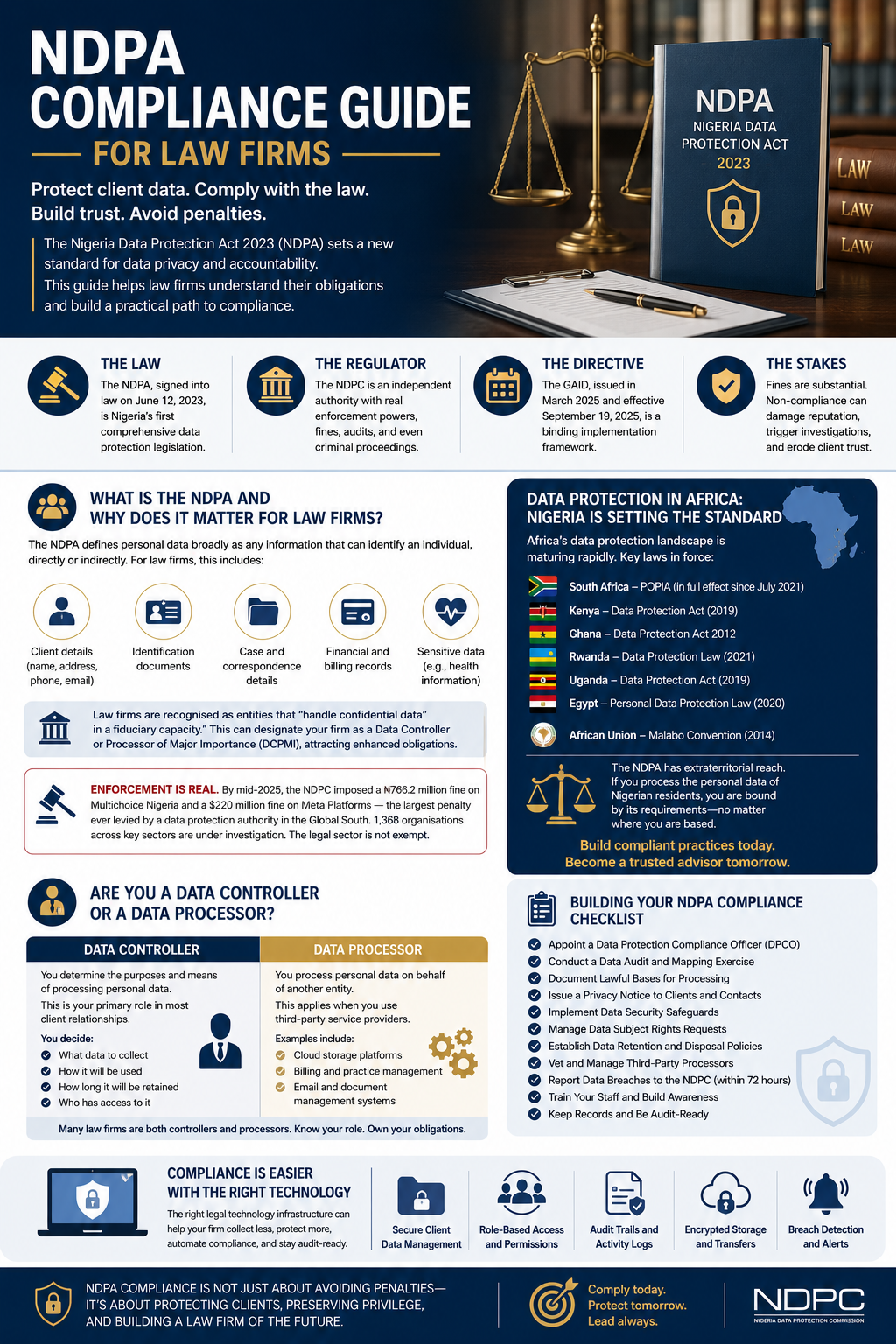
There is an irony that legal professionals tend to overlook. Law firms — the very institutions that advise clients on regulatory compliance — are themselves regulated data controllers with significant obligations under Nigeria’s data protection framework. And in 2026, the stakes for non-compliance have never been higher.
The Nigeria Data Protection Act 2023 (NDPA), signed into law on June 12, 2023 by President Bola Ahmed Tinubu, is Nigeria’s first comprehensive data protection legislation. It replaced the Nigeria Data Protection Regulation 2019 (NDPR), which critics had long described as a regulation without adequate legislative teeth. The NDPA changed that entirely — establishing the Nigeria Data Protection Commission (NDPC) as an independent regulatory authority with real enforcement powers, and extending its reach to every organisation that handles the personal data of Nigerian residents, including law firms.
Then, in March 2025, the NDPC issued the General Application and Implementation Directive (GAID), which took effect on September 19, 2025. The GAID is not optional guidance — it is a binding implementation framework that, together with the NDPA, now constitutes the complete governing architecture for data protection in Nigeria. The NDPR 2019 and its Implementation Framework have been formally retired.
What does all of this mean for your law firm? It means that the way you collect, store, process, and protect your clients’ personal data is no longer a matter of professional discretion alone. It is now a matter of law — with fines, audits, and potential criminal proceedings for firms that fail to comply.
This guide breaks down everything legal professionals across Nigeria and Africa need to understand about NDPA compliance — from foundational principles to a practical compliance checklist — and explains how the right legal technology infrastructure can make compliance manageable rather than overwhelming.
The NDPA defines personal data broadly as any information that can identify an individual, directly or indirectly. For law firms, this encompasses an enormous volume of daily operational data: client names, addresses, phone numbers, email addresses, identification documents, financial records, case details, health information in personal injury matters, and even the metadata of legal correspondence.
Every time your firm opens a new client file, sends an email to a client, stores a document in a cloud repository, or uses a third-party billing platform, it is processing personal data. The NDPA governs all of it.
Law firms are specifically recognised in the NDPA’s framework as entities that ‘handle confidential data in a fiduciary capacity.’ This classification matters because it can trigger the firm’s designation as a Data Controller or Processor of Major Importance (DCPMI) — a category that carries significantly enhanced compliance obligations.
The NDPC has already demonstrated it takes enforcement seriously. By mid-2025, the Commission had imposed a ₦766.2 million fine on Multichoice Nigeria and a $220 million fine on Meta Platforms — the largest penalty ever levied by a data protection authority in the Global South. In August 2025, the NDPC launched investigations into 1,368 organisations across banking, insurance, pension, and gaming sectors. The legal sector is not exempt, and the Nigerian Bar Association’s Section on Legal Practice has already drafted privacy guidance for lawyers in acknowledgment of the NDPA’s direct application to legal practice.
Nigeria’s NDPA does not exist in isolation. Across the African continent, data protection frameworks are maturing rapidly — and Nigeria’s legislation is among the most sophisticated on the continent.
Key African data protection laws in force include:
For Nigerian law firms with cross-border practices — particularly those handling diaspora clients, international arbitration, or pan-African corporate mandates — the compliance picture is multilayered. You may be processing personal data subject to both Nigerian and South African or Kenyan data protection law simultaneously. The NDPA’s extraterritorial provisions mean that foreign law firms processing the personal data of Nigerian residents are also bound by its requirements, regardless of where the firm is headquartered.
The direction of travel is clear. Data protection compliance in Africa is not a future consideration — it is a present legal obligation. Law firms that build compliant data practices now will not only avoid penalties; they will position themselves as trusted advisors in an era where clients are increasingly aware of their data rights.
Before a law firm can build a compliance framework, it must understand which legal role it occupies under the NDPA.
As a Data Controller, your law firm determines the purposes and means of processing personal data. This is the firm’s primary role in most client relationships — you decide what data to collect during client intake, how it will be used, how long it will be retained, and who has access to it.
As a Data Processor, your firm processes personal data on behalf of another entity. This may apply when your firm uses third-party service providers — cloud storage platforms, billing software, email management systems — that handle client data under your direction.
In most cases, law firms function as data controllers. However, any third-party software or service that touches client data — your document management system, your casefile management platform, your payment processor — is functioning as a data processor, and the NDPA requires that a formal Data Processing Agreement (DPA) be in place between your firm and each processor.
Compliance Gap Alert
This is a compliance gap that the vast majority of Nigerian law firms have not yet addressed. If your firm is using any external software to store, manage, or process client information without a signed data processing agreement, you are already in non-compliance with the NDPA.
The NDPA requires that every instance of personal data processing must rest on a lawful basis. For law firms, the most relevant bases include:
The key point is that a lawful basis cannot be assumed or applied retroactively. Your firm must identify the applicable legal basis before processing begins, and this determination must be documented.
Under the NDPA’s core principles, you may only collect personal data that is adequate, relevant, and limited to what is necessary for the specified purpose. Collecting a client’s national identification number for a property transaction is proportionate. Collecting it for a routine consultation call is not.
Purpose limitation means that data collected for one purpose cannot be repurposed for an unrelated activity without obtaining fresh consent. This has direct implications for marketing — you cannot use a client’s contact details collected during legal representation to send them promotional emails without their explicit consent.
Before collecting any personal data, your firm must inform clients of how their data will be used. This means having a clear, accessible privacy policy that explains:
This is not a one-page disclaimer buried in your client engagement letter. It must be written in plain, accessible language — and it must be provided to clients before or at the point of data collection.
The NDPA grants individuals specific rights over their personal data. As a law firm, you must be equipped to respond to these rights requests:
The challenge for law firms is that client data is often intertwined with confidential case strategy and work product. Your firm needs a policy for responding to these requests in a way that respects both data subject rights and professional legal obligations, including privilege.
The NDPA and GAID require that a Data Protection Impact Assessment be conducted before any processing activity is likely to pose a high risk to the rights and freedoms of data subjects. For law firms, this applies to:
A DPIA is not a one-time exercise. It must be reviewed whenever the underlying processing changes significantly.
Under the NDPA, if your firm experiences a data breach likely to pose a high risk to individuals, you are required to notify the NDPC within 72 hours of becoming aware of the breach. If the breach poses a high risk to affected clients, you must also notify them directly.
You must also maintain a breach register documenting the nature of the breach, the data involved, its likely consequences, and the remedial measures taken. This is not negotiable — failure to report a qualifying breach attracts fines of up to ₦5,000,000 or 2% of annual gross revenue.
If your firm processes the personal data of more than 200 data subjects within a six-month period — which virtually any law firm with an active caseload will — you are likely required to register with the NDPC as a Data Controller or Processor of Major Importance. This registration must be done online through the NDPC’s portal, with applicable registration fees.
DCPMIs face additional obligations: mandatory annual compliance audit returns (due by March 31 each year), appointment of a Data Protection Officer, and ongoing engagement with NDPC on data processing matters.
DPO appointment is mandatory for DCPMIs. The DPO must have expert knowledge of data protection law, must monitor the firm’s compliance with the NDPA, advise staff on data protection obligations, and serve as the firm’s point of contact with the NDPC.
The DPO may be an internal employee or an external consultant engaged via a service contract. For smaller firms, engaging an external DPO through a licensed Data Protection Compliance Organisation (DPCO) is a practical and cost-effective option.
For law firms handling international matters — cross-border commercial transactions, diaspora client work, international arbitration — the NDPA imposes strict rules on transferring personal data outside Nigeria. Transfers are only permitted where the recipient country provides an equivalent level of data protection to what the NDPA guarantees inside Nigeria, or where one of the permitted exceptions applies (explicit consent, contractual necessity, public interest, or legal claims).
All cross-border data transfers must be documented, with the firm able to demonstrate the legal basis for each transfer if required by the NDPC.
This is one of the most important nuances for Nigerian law firms to understand, and one that very few compliance guides address specifically.
Attorney-client privilege and the NDPA operate in different dimensions — but they can intersect in ways that require careful navigation. The Freedom of Information Act 2011 expressly recognises that public institutions may refuse disclosure of information subject to legal professional privilege. The NDPA does not abolish privilege.
However, privilege does not exempt law firms from data protection obligations in their capacity as data controllers. A client asserting their right to access their personal data under the NDPA is not the same as seeking disclosure of privileged work product. Your firm’s compliance framework must address how data subject rights requests will be handled in a way that honours both the client’s NDPA rights and the firm’s professional obligations — including appropriate redaction of genuinely privileged material where the two overlap.
This is complex territory that requires a clearly documented internal policy, not improvised responses to requests as they arise.
The NDPA’s enforcement regime is not a matter of theoretical risk. Here is what your firm faces for non-compliance:
| Violation | Maximum Penalty |
| Failure to comply with NDPC orders | ₦10,000,000 or 2% of annual gross revenue (whichever is greater) |
| Unauthorized data processing | ₦2,000,000 or 2% of annual gross revenue |
| Failure to report a data breach | ₦5,000,000 or 2% of annual gross revenue |
| Failure to register as a DCPMI | Fine + deemed to be in breach of the NDPA |
Beyond monetary penalties, the NDPC may institute criminal proceedings for serious violations. Principal officers of the firm — partners and directors — may be personally deemed culpable under the Act. For a law firm, reputational damage from an NDPC enforcement action could be as damaging as the financial penalty itself.
Use this checklist to audit your firm’s current compliance position:
FOUNDATION
GOVERNANCE
THIRD PARTIES
OPERATIONS
ONGOING
One of the most common objections to compliance is operational: law firms are busy, partners are billable, and administrative overhead is already a burden. But the reality is that the right legal technology infrastructure does not add to the compliance burden — it carries much of it.
A well-implemented case file management system provides the structural backbone of NDPA compliance for law firms. Consider what this means in practice:
Role-Based Access Controls: Ensure that only the right people see the right files — satisfying the NDPA’s requirements for technical and organisational security measures, and enabling your firm to disable local downloads for specific team members to prevent unauthorised data distribution.
Encrypted Cloud Storage: Addresses the NDPA’s requirement that personal data be protected with appropriate technical safeguards, including encryption and secure processing systems.
Audit Trails and Version Control: Create the records of processing activities that the NDPA requires data controllers to maintain.
Client Intake Workflows: Capture consent at the point of data collection and provide the documented, verifiable consent logs the NDPC may request during a compliance audit.
AI-Assisted Document Search: Enables rapid responses to data subject access requests — your firm can locate all personal data held for a specific data subject across an entire case file repository in seconds, not days.
The NDPA 2023 and the GAID 2025 have transformed data protection in Nigeria from an aspiration into an obligation. For law firms, this transformation carries both risk and opportunity.
The risk is straightforward: firms that continue to treat client data casually — relying on habit, engagement letter boilerplate, and informal practices — are exposed to NDPC enforcement, fines, reputational damage, and the erosion of client trust that a data breach inevitably produces.
The opportunity is equally clear: law firms that build robust data protection practices now will differentiate themselves in a market where sophisticated clients are increasingly asking hard questions about how their information is handled. NDPA compliance is not just a legal obligation — it is a competitive signal that your firm takes its fiduciary duties seriously in the digital age.
The compliance journey is not simple. But it is structured. And with the right technology infrastructure and the right advisory support, it is entirely achievable — without disrupting the work that matters most.
At Techlava Softwares, we build legal technology solutions that are designed for the Nigerian legal environment — including the compliance requirements of the NDPA. Our SoftDox case file management system comes with the security architecture, access controls, encrypted storage, and audit trail capabilities that form the technical backbone of NDPA compliance for law firms.
Whether you are evaluating your current compliance posture, implementing a new case management system, or navigating the intersection of NDPA obligations and legal professional privilege, we are here to help.