Physical Address
304 North Cardinal St.
Dorchester Center, MA 02124
Physical Address
304 North Cardinal St.
Dorchester Center, MA 02124

For business owners, startup founders, and professionals, understanding the key tech trends shaping 2026 is no longer optional. It helps you make smarter decisions, reduce risk, and stay competitive. Below are the most important trends Nigerian businesses should pay attention to—and what they mean in practical terms.
Nigeria’s business environment is changing fast. More people are online, payments are becoming digital, and businesses are relying on technology to grow and survive. At the same time, government reforms and regional trade agreements are opening new opportunities.
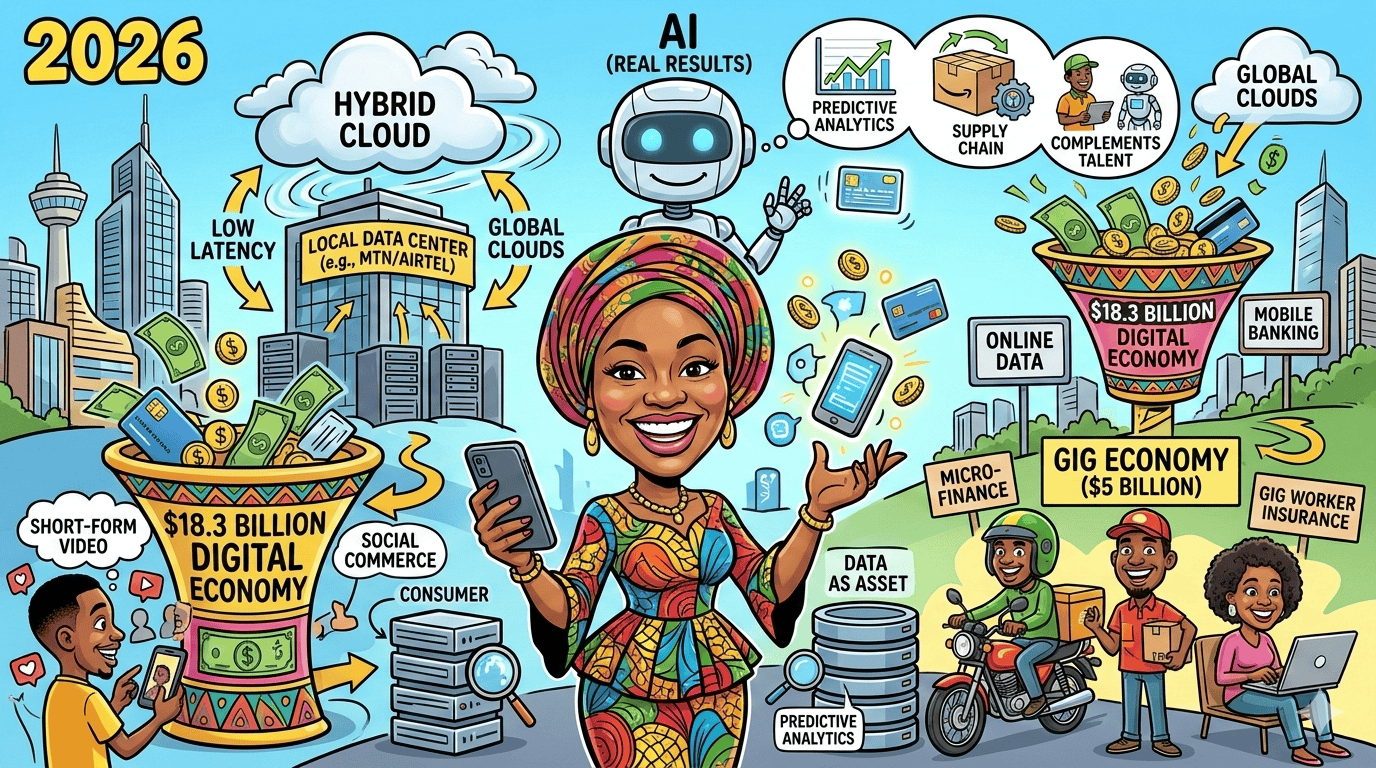
Nigeria’s online economy is expected to reach $18.3 billion by 2026. This is happening because more people are using mobile banking, shopping on their phones, and using better internet. Selling online is no longer an “extra” option—it is now the main way to grow. Businesses must use digital payments and use online data to make better sales decisions.
Artificial intelligence (AI) is moving beyond pilot projects. Globally, 2026 is expected to mark the shift from AI experimentation to accountable, outcome‑oriented deployment, and Nigerian businesses that integrate AI into supply chain, customer insight and pricing analytics will gain a competitive advantage. Across Africa, 26 % of companies plan to allocate over 20 % of their tech budgets to AI, while cybersecurity remains the top priority at 45%.
CEOs are optimistic: roughly 78 % expect growth going into 2026, and 88 % intend to hire more staff rather than reduce headcount. This underscores that AI adoption complements human talent. In Nigeria, AI applications range from precision agriculture to AI‑powered HR tools and customer support bots. Businesses should invest in relevant AI solutions—such as predictive analytics for logistics, chatbots for customer service and machine‑learning models for fraud detection—while also training employees to work alongside AI.
Emerging technologies like hybrid cloud and AI supercomputing platforms enable organisations to orchestrate complex workloads efficiently. By 2026, Nigerian enterprises will rely on scalable infrastructure that blends on‑premises servers, public clouds and edge computing. Data localisation is becoming a priority due to sovereignty concerns and the need for lower latency. Telecom operators such as MTN Nigeria are launching modular data centres to support local hosting and cloud services, while Airtel Nigeria expands fibre capacity. These investments reduce latency, lower foreign exchange exposure and improve reliability. Businesses should consider hybrid architectures that combine local data centres with global clouds, ensuring regulatory compliance while maintaining access to advanced services.
Nigeria’s gig economy contributes nearly $5 billion annually, with millions of workers participating in ride‑hailing, delivery and digital freelancing. The shift from informal side hustles to mainstream income sources creates opportunities for platforms that offer micro‑finance, talent marketplaces and logistics services. Businesses can leverage gig platforms for flexible staffing, last‑mile delivery and specialised services. For entrepreneurs, building solutions that support gig workers—such as insurance, payment systems and upskilling programmes—represents a growing market.
Data has become a core competitive asset. Companies that aggregate and monetise proprietary data gain structural advantages. In Nigeria, businesses must invest in data capabilities—such as customer segmentation, predictive analytics and supply chain optimisation—to enable scalable growth. Meanwhile, consumer behaviour is shifting toward short‑form video and creator‑led commerce. Social commerce is projected to grow into a multi‑trillion‑dollar ecosystem. Local brands must integrate social commerce strategies, leveraging content, influencers and immersive experiences to engage customers across video‑first platforms.